Raleted

Thứ Bảy, 24 tháng 3, 2012

HCM City eyes long-distance river tour to Cambodia
The HCMC Department of Culture, Sports and Tourism will conduct a survey on a long-distance river tour from Bach Dang Wharf in the city’s District 1 to Cambodia, as the short-distance tours have started to get customers.


Nguyen Viet Anh, head of the Travel Division under the department, said his agency is making a specific plan to submit to the HCMC government. The department expects to have kicked off the survey by the end of this year.

“The earlier-opened river tours such as Bach Dang-District 2, Bach Dang-Can Gio and Can Gio-Phu My have begun to attract customers. We will continue to launch more tours under the plan to develop river tourism in HCMC,” said Anh.

Developing river tourism is one of the key plans of HCMC, with the focus laid on Can Gio. The city last year opened the short-distance river tour from Bach Dang Wharf to Ham Long Artisan Village in District 2, followed by the Bach Dang-Can Gio route.

Several tours connecting the city to Dong Nai and Binh Duong have also been studied. Above all, the tour from Can Gio to Phu My Port in Ba Ria-Vung Tau is the most notable with a series of marketing activities, building cruise ships and kayaks to lure international tourists.

Phan Xuan Anh, chairman of Viet Excursions, said since the river tour was piloted in November 2011, his company has sold Can Gio mangrove forest tours and kayaking tours to some 1,000 foreign visitors on board the German cruise ships that drop anchors at Phu My Port. It takes only 15 minutes for tourists to travel from Phu My to Can Gio by river, but no enterprise considered developing this route before.

“Cruise ship passengers are really excited about the new form of tourism in Can Gio. Previously, we organized only one trip to Can Gio a day, but now the cruise liners demand one more. We have started to sell this tour to U.S. cruise ships,” said the director.

Viet Excursions has joined hands with the management board of Can Gio Biosphere Reserve to develop infrastructure and train staff for the river tour. The tour operator has bought 30 kayaks and built one river cruise ship, while its partner has also built a ship to take tourists to the mangrove forest.

“River tours are appealing to international visitors. If HCMC continues to promote this tourism route further by developing ports for river cruise ships, the city will have an attractive type of tourism,” said Xuan Anh.

SGT

Thứ Sáu, 23 tháng 3, 2012

Vung Tau

Vung Tau photos
The quieter bay
The quieter bay
Mary holding jesus
Mary holding jesus
Buddha
Buddha
While Vung Tau may not be my favourite place in Vietnam, it makes for a very quick escape from the city. With a ticket on the hydrofoil from Ho Chi Minh City costing just over $10 and taking just over an hour you can escape the big smoke and be on the beach long before you go stir crazy.
Despite a slightly seedy reputation its not a bad place to get away when you're short on time and can't face the journey to Mui Ne. Once a popular destination for the colonial French the town is overlooked by a huge statue of Jesus on top of a nearby hill, similar to the one that looks out over Brazil.
The town itself looks out onto a pretty harbour full of brightly painted blue fishingboats typical of southern Viet Nam.
To the right of the bay is a road that snakes around the coast beneath Jesus' feet, leading to a huge long beach bustling with fellow escapees from Saigon, where there are many restaurants, cafes and hotels.
If you follow the road to the right you will find a far quieter bay, with two huge statues on the hill - one of Mary holding Jesus, and further down the coast a huge statue of Buddha.
Food, drink and accomodation in Vung Tau is all pretty cheap and there are some great deals to be had. There is also a wide range of accommodation from high quality hotels to cheap guesthouses and homestays which can be had for under $10 a night.

Thứ Ba, 20 tháng 3, 2012

Can Gio Mangrove Forest

Can Gio Mangrove Forest photos
Bicycle on a bridge, Can Gio
Can Gio Hairdressers
Ferry to Can Gio
Ferry to Can Gio
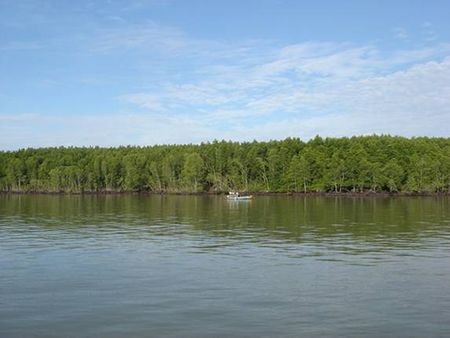
Known as the 'green lungs of Saigon', the Can Gio biosphere reserve to the south of the city covers around 80,000 ha of the river delta and is cloaked in rich mangrove forest that is full of wildlife, with over 200 species of fauna and 52 flora. This huge mass of green so close to the centre of Ho Chi Minh City helps clean the air of the city, and protect against coastal erosion and storms coming in from the sea.
The mangrove forest in Can Gio was originally over 2000 years old, and so dense that the interior was cold, foggy and dark, and full of dangerous animals such as tigers and crocodiles. During the war the mangroves were a dense hiding place from which to launch attacks on the city, which both the Vietnamese and Americans found extremely difficult to penetrate or patrol. Sadly this lead to the Americans dropping a huge amount of chemical defoliant or dixoins on the area, significantly damaging the mangrove forest, in an attempt to maintain control.
Now the mangrove is beginning to recover and is protected by the government and international law, and there are efforts to reintroduce much of the wildlife that fled the area. It is a great place to visit from Saigon, whether as a day trip or for a longer stay - there is a resort to the south with a pool and small (though slightly muddy) beach.
I loved Can Gio, and have been back several times since - it is particularly special as when you live in Saigon it seems you must drive for hours to escape to the countryside, yet just an hour south is this beautiful, thoroughly rural nature reserve. You can make the trip by motorbike - through District 7, then south through Nha Be until you cross the Nha Be river by ferry. From there head south through Can Gio to head deeper into the mangroves. We took a boat trip to explore by water, stopping off at some nature reserves and spotting all kinds of wildlife, and I can highly recommend it.
Another option is to take a ferry to Can Gio from Bach Dang wharf in Saigon, which will take you down the rivers and canals to Can Gio - I've not done this trip but I expect its a great option for those without bikes - or to book a tour of Can Gio, either locally or online through Isango.
Its worth noting that Can Gio is the poorest district of Ho Chi Minh City, with most people making their money from fishing and catching crabs, so while you are there do try to spend some money in local shops and food stalls, tip your guide or boat crew and if you like the area, consider staying in one of the hotels or guesthouses in the region.
I forgot my camera when we took a boat trip, so my photos are mainly of our bike ride round the north of Can Gio province - you can see some good photos of themangroves on flickr - and of the sea shore on the other side of Can Gio at Phuong Nam Pearl Resort.

Thứ Hai, 19 tháng 3, 2012

Saigon

Saigon photos
Notre Dame Cathedral
Saigon Opera House at night
Ho Chi Minh City Town Hall
Saigon Traffic
Saigon Traffic
Boats on a canal in District 7
While it may not be the capital of Vietnam politically, you only need to spend a short time in Saigon to see how it the pace of change in the south is shaping the country. The largest city in the country, with over 6 million inhabitants (and over 8 if you count temporary residents), Saigon is a crowded, fast, noisy, and overwhelming place at first. Dig a little deeper, though, and you'll find there is an energy and vibrancy to the city that can be very infectious.
Brimming with life, Ho Chi Minh City (HCMC or Saigon as the majority of its residents still call it) offers a great deal for travellers and expatriates alike. There's a great deal to see and do, and no shortage of delicious treats to eat, whether at top restaurants or equally delicious street stalls for a couple of dollars.
The pace of change in the city is staggering - on a daily basis buildings are pulled down so newer, shinier ones can be erected in their place. In around ten years the city went from a city of 3,000,000 bicycles to 5,000,000 motorbikes, leading the Saigon's very unique brand of traffic. Now car use is on the rise gridlock threatens to set in, but it is yet another reminder of how fast lives are changing in HCMC, and how more and more people are working their way out of poverty.
Yet with a closer look you can find beautiful old buildings as well as striking new ones, cool, calm cafes with gardens that are set back from the road to give you a moments rest from the madness outside, relaxing spas and cool pools to swim in.
There's also a number of great day trips that can be done from the site, whether to Tay Ninh mountain and the Cao Dai temples in the North West, the famous Cu Chi Tunnels where the resistance launched sneak attacks on the US forces based in Saigon, boat trips to Vung Tau, the Mekong Delta or to Can Gio, the huge area of mangrove swamps to the south, known as 'the lungs of the city'.

Related Links

Asia Life - Magazine with places to eat drink and more
The Word HCMC - Competing magazine with a good website
Saigon Childrens Charity - Great charity working to help the children of South Vietnam. Run the annual Saigon Cyclo Challenge event
People's Committee of HCMC
Chefmoz: HCMC More reviews of HCMC restaurants

Thứ Bảy, 17 tháng 3, 2012

SummaryGio is a coastal district located in south-east of Ho Chi Minh City, about 50 km from the center. In 1997, the district has an area of ​​714 km ², a population of 55,173 people, including the Kinh (80%), Khmer and Cham. Gio including towns and 6 communes Can Thanh Binh Khanh, An Thoi Dong, Ly Nhon, Tam Thon Hiep, Long An and Thanh Hoa.
The area of ​​the district is 704.2 km ². The terrain is divided by rivers and canals, there is no fresh water. Probability and mangrove forests, forest land accounts for 47.25% of the area.Gio Sea access and presence of a mangrove forest interlaced with rivers and dense system containing ecosystems of high biological diversity with many species endemic to the Vietnamese coast South, it's Can Gio mangrove forest.This district has 69 large and small islets.
Gio has eight temples, 2 temples of the Pure Land sect Lay; contain only two German (Can Thanh Commune), Tathagata Quang Minh Temple (Binh Khanh commune) and Temple of Nhon Hoa (Ly Nhon commune) is tu Dr. Abbot. Thanh Phuoc Pagoda (Pagoda Tree Me) Can Thanh Commune is more ancient temple.
Potential phytosanitary populations particularly rich and diversified along with the ability to restore and care for human magic has been revived Can Gio - a waste land by toxic chemicals in war-zone nature conservation, a major tourist attraction and foreign tourists.
Conservation area Gio mangrove forest (Can Gio district, Ho Chi Minh City) is one of the typical mangrove forests in tropical coastal areas, not only offers a wide range of forest products but also habitats of many marine species, waterfowl, migratory birds and several species of terrestrial amphibians.
Một góc khu sinh quyển Cần GiờA corner Gio biosphereThis is the first mangrove forest in Vietnam is recognized as the World Biosphere Reserve.
With many types of tourism such as resorts, ecotourism, scientific research, Gio attractions with a rich choice: Gio Forest Park visit for those who prefer action-research system to animals; visit the island raising thousands of free-living monkeys in the forest to visit a natural bird sanctuary with more than 100 ha area or enjoy the natural beauty rare in tangles.

Thứ Sáu, 16 tháng 3, 2012


Buon Ma Thuot

The Central Highlands of Vietnam may be off the beaten track compared to some of Vietnam's more popular tourist destinations, but that doesn't mean the Highlands don't have something to offer. Dak Lak Province (also spelled Dac Lac) is one of these lesser known areas of Vietnam that nevertheless is well-worth a visit.

Buon Ma Thuot

In southern Vietnam's Central Highlands, not too far from the Cambodian border, is the city of Buon Ma Thuot. Unlike Ho Chi Minh City, Hanoi, and Da Nang, all of which have seen a significant bump in western tourism over the past decade or two, Buon Ma Thuot remains well off the beaten track. In other words, in Buon Ma Thuot, you'll get to witness a glimpse of the “real” Vietnam.
Buon Ma Thuot (also spelled Buon Ma Thuat or Ban Me Thuot) is the capital of Dak Lak Province. A bustling small city of about 300,000 people, it is the largest city in the Central Highlands region, and provides a great launch pad for adventures into attractions of the Central Highlands.
Fifty kilometres from Buon Ma Thuot, you can find the Don commune, which is the home to some of the very best elephant trainers in all of Southeast Asia. With a long history due to their prominence as elephant traders, the Don commune includes Cham towers and tombs that date back to the 13th century. Long since covered with moss, the tombs were once the burial grounds of wealthy tribal chiefs

Dak Lak Province and its Elephants

Buon Ma Thuot is the capital city of the province of Dak Lak, a province of lakes and waterfalls, rich forests, and ethnic minorities. During French rule, Dak Lak was a region of plantations, and coffee is still the main export from Dak Lak today, but when the Vietnamese rebelled against their colonisers during the First Indochina War, the region's minority tribes led quite a few of the rebellions themselves. The tribes had the same response to the American forces who came in during the Vietnam War; fighting was heavy in the 1960s and 70s during the war, and the first North Vietnamese tank to enter Buon Ma Thuot remains in the centre of the city as a reminder of this era.
The most famous residents of Dak Lak Province, however, are its elephants. The people of the Central Highlands have been known as phenomenal elephant riders and trainers for centuries now, and most tourists who visit Dak Lak can't pass up the opportunity to go for a ride on the back of one of these elephants.
In 2009, the province began work on a 200 hectare elephant sanctuary to protect both wild and domestic elephants. Located in Yok Don National Park, the elephant sanctuary is designed to protect one of the region's most precious natural resources. Dak Lak only has less than 115 wild elephants remaining, and even the domesticated elephant population is starting to rapidly shrink due to improper care and breeding techniques.

Yok Don National Park

Yok Don is one of the largest national parks in Vietnam - however it must be said it is not one of the most exciting to visit. A large part of the area reserved as parkland - and the area you are most likely to see on a short visit - has been replanted recently, and so there is none of the impressive old-growth forest with old trunks and creepers intertwining, more a fairly regular plantation of trees.
While it is commendable that the government is making an effort to replant forest that has been lost, it is unlikely the casual visitor will get as much out of a trip to Yok Don as they might from Cuc Phuong or Cat Tien parks where on arrival the visitor is already in fairly deep jungle, and the wilderness lies not to far from where you sleep. That being said, the area outside the park, around Yok Don and Buon Ma Thuot - and in particular the waterfalls - is stunningingly beautiful and definitely worth exploring.

Dray Sap Falls

Not far from Buon Ma Thuot are the Dray Sap falls, beautiful, broad waterfalls set in a horseshoe shape. Beyond the first set of falls are two more, all equally impressive. Although the falls aren't particularly high, they are very long. Swimming in the pools beneath the falls is not advisable, although some people enjoy trying anyway.
The area around the waterfalls include old growth forests, including banyan trees and willows, crisscrossed by vines and other plant foliage. A variety of birds and other wildlife can be spotted amongst these older trees. At the entrance of the falls is a kiosk area, which sells cold beverages and plenty of postcards.
Although it's not as famous, the close by Gia Long waterfall is also worth seeing while you're visiting the Dray Sap falls. During the dry season, Gia Long disappears to a mere trickle, but even then the steep rock formations around the falls are worth climbing and exploring for adventurous types.

Lak Lake

A little more than fifty kilometres from Buon Ma Thuot is Lak Lake. Home to one of the palaces of the last emperor of Vietnam, Bao Dai, the valley and the 500 hectare lake is used as a resort getaway for wealthy Vietnamese. Today you can visit the palace of the emperor, and enjoy a panoramic view of the valley from his second floor balcony.
Tourists often enjoy traversing the lake in a dug-out canoe, travelling to different spots to see the lake's beautiful lotuses. Even though the lake is a very popular tourist destination, it's still wild, providing the local population with an abundance of fresh fish each year.
The Central Highlands region of Vietnam is filled with ethnic minorities and hill tribes that have inhabited the area for many centuries, and the area around Lak Lake is no different. On the south shores of the lake lies Jun Village, a traditional village of the M'nong people. With wood and rattan houses propped on stilts, and farm animals wandering through the street, Jun Village provides an educational glimpse into the daily lives of some of these rural hill people. For the adventurous visitor, you can rent a mattress for the night in one of the stilt longhouses for a mere £3.50.
Buon Ma Thuot and the surrounding area provide an intimate look at Vietnam that the tourists who stick to the big cities never get to see. If you're planning on exploring the Central Highlands, Buon Ma Thuot provides an excellent base of operations. From there, it's easy to trek out into various parts of Dak Lak Province, including Dray Sap falls, Lak Lake, and other popular spots.

Getting to and from Buon Ma Thuot

Buon Ma Thuot is a short but visually stunning 3hr drive from Nha Trang. The road from Dalat is also incredibly beautiful, though the road is extremely windy so it is not great for those who suffer from car sickness (read: most of your fellow passengers). From Buon Ma Thuot you may wish to continue on to Kon Tum or head back down to the coast at Nha Trang or Quy Nhon.
For exploring the region you are likely to need your own transport. Motorbikes can be hired in the town and there are numerous travel agents that can book tours, however you may wish to arrange these before you arrive.

Chủ Nhật, 26 tháng 2, 2012

Phuong Nam pearl resort


        Nằm giữa dòng chảy của hai con sông Soài Rạp và Lòng Tàu, Khu Du lịch Sinh Thái biển Hòn Ngọc Phương Nam mang trong mình những cánh rừng và bãi biển đẹp nhất của Khu Dự trữ sinh quyển của thế giới, đó là rừng ngập mặn Cần Giờ thuộc xã Long Hoà, huyện cần Giờ, cách Thành phố Hồ Chí Minh 65 Km.  
 

Với vị trí thoáng mát, khang trang và khung cảnh hữu tình, Nhà hàng Phương Nam luôn luôn phục vụ các món ăn đặc sản tươi sống như Tôm hùm, Tôm sú, Cá Diêu hồng, Cá mú, Dông nướng, Ghẹ, Ốc hương, Ốc giác, Ốc nhảy, nghêu, sò huyết... và các món ăn truyền thống của Đồng quê, làng chài.Đặc biệt là các món ăn Âu á cao cấp khác.
      tiếp theo 

Khách sạn Phương Nam nằm sát bờ biển, được xây dựng hài hoà với thiên nhiên rừng và biển.
Khách sạn có  07 loại phòng ngủ được trang bị đầy đủ máy lạnh, nước nóng, bồn tắm, ti vi truyền hình Cáp, tủ lạnh, điện thoại…
           tiếp theo 


Khu du lịch Hòn Ngọc Phương Nam cung cấp du khách các dịch vụ như:  Du lịch sinh thái, Du Lịch nghĩ dưỡng biển, Tham quan - giáo dục bảo tồn, Du Lịch Thể thao, Du lịch Cuối tuần:
tiếp theo